
Custom Design
Imagine this: You’ve finally run your paid campaign with a ₹50,000 monthly budget, confident in reaching your target audience. Three weeks pass, and you’re faced with disappointing results—high cost, low conversions, and an aching suspicion that your money disappeared without bringing significant results.
This is a situation that repeats itself on a daily basis for countless companies. Successful paid campaigns and costly failures often hinge on sound platform choice and careful paid campaign setup. When you get these basics right, your ad spending becomes a finely tuned instrument that generates returns consistently instead of an expensive shot in the dark.
We’ll guide you through the entire process of choosing the proper digital advertising channels, executing campaigns with zero waste, and creating systems that convert your ad spend into paying customers. You’ll learn effective tactics that enable you to reach more high-quality prospects for fewer dollars, providing your company with the edge of competition it requires.

Strategic choice of paid campaign platform involves selecting the individual digital advertising platforms that most closely align with your business objectives, target audience behavior, and budget. Instead of dispersing your funds across all available platforms, you methodically assess where your perfect customers spend their time and how they prefer to interact with brands.
This mindset repositions your advertising from disjointed efforts into targeted investments. When you know which platforms yield the greatest return for your unique business model, you can spend money more efficiently and get greater results with less.
The actual power is in how this strategic thinking impacts your bottom line. Companies that excel at platform selection typically experience 40-60% decreases in cost per acquisition while reaching higher-quality prospects. Your campaigns become more predictable, scalable, and profitable.

Platform choice has a direct influence on all facets of your advertising effectiveness. Making an incorrect choice can burn through your budget rapidly while providing low-quality leads that seldom convert.
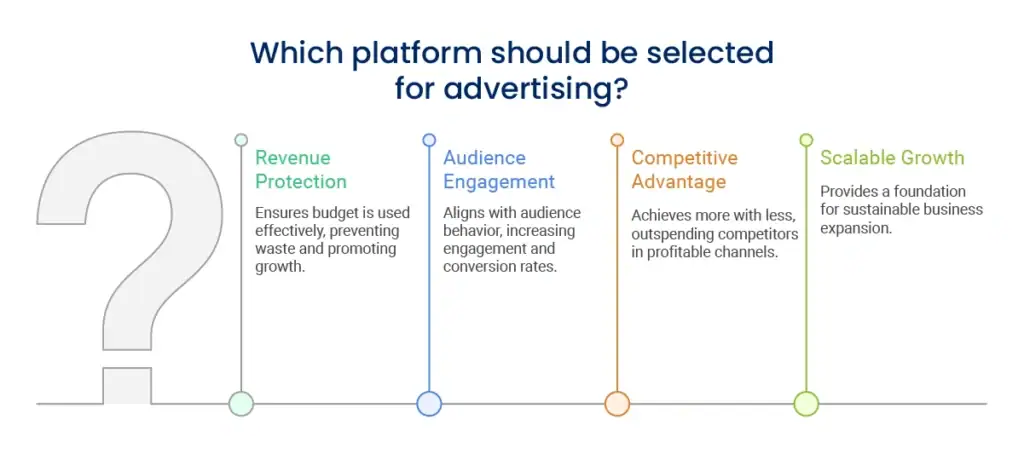
Your ad budget is a considerable investment in your business expansion. Careful platform choice allows this investment to yield regular dividends instead of vanishing in useless avenues. You safeguard your finances while optimising growth potential.
While others spend money wastefully on inappropriate platforms, your laser-guided strategy achieves more with less. This advantage of efficiency snowballs over time, enabling you to outspend others in profitable channels while keeping healthier margins.
Different platforms have different user attitudes and behaviors. Your audience on LinkedIn is different from your audience on Instagram, and your audience on TikTok is a whole different ball game. Selecting platforms that align with your audience's natural behavior patterns equates to more engagement and improved conversion rates.
Appropriate platform choice lays the groundwork for sustainable growth. When you know your highest-performing channels, you can invest with confidence knowing the returns will be there. This is what makes business planning more precise and expansion more sustainable.
Knowing the key components of successful paid campaigns enables you to develop systems that execute consistently on different platforms and audience segments.
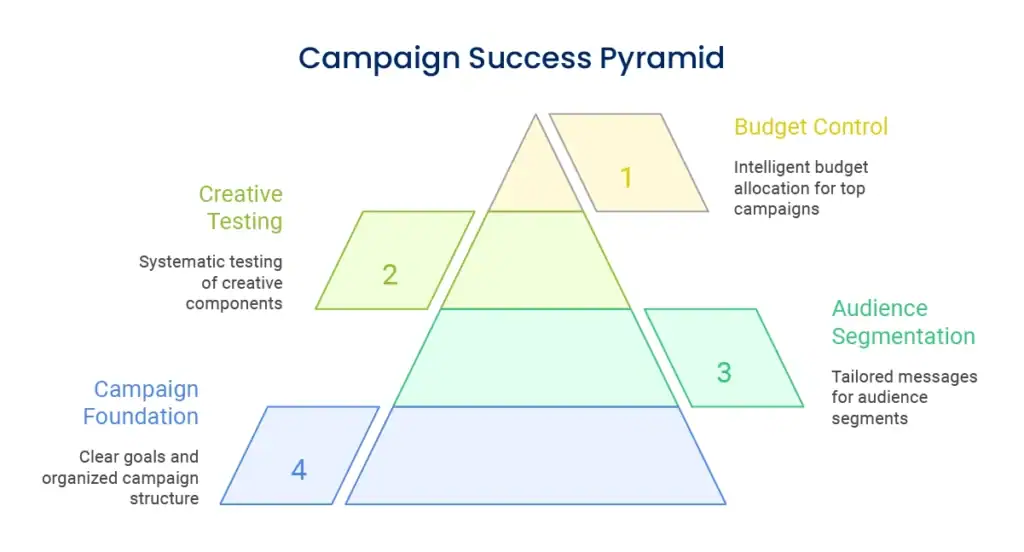
Your Paid campaign foundation sets everything in motion. Begin by setting clear goals that tie directly back to business results—whether direct sales, lead generation, or brand awareness with quantifiable engagement metrics.
Organize your campaigns into rational buckets that are easy to manage and optimize. Clustering like products, services, or audience groups together allows you to quickly see what is working and duplicate winning strategies. This organization allows you to troubleshoot issues more quickly and scale winners more effectively.
Successful audience development involves more than general demographics. You must know the entire customer journey and pinpoint where various audience segments are at on that journey.
Develop separate audience groups by levels of engagement and purchasing intent. Cold audiences need one message and offer versus warm leads who have already indicated interest. By segmenting this way, you can tailor your approach for greatest relevance and conversion value.
Your creative components—headlines, images, videos, and copy—require systematic testing and development procedures. Develop multiple versions of each Paid campaign component so you can determine what works best with your audience.
Set up testing procedures that provide you with accurate information regarding creative performance. This involves testing a single variable at a time, testing long enough to collect statistically valid data, and tracking results so you can apply learnings to subsequent campaigns.
Intelligent budget handling avoids waste while providing your top-performing campaigns with sufficient funding. Use automated rules and budgets that guard against surprise overspending while enabling successful campaigns to expand.
Carefully track your spend patterns and make allocation adjustments according to performance metrics. Your budget must direct itself into Paid campaigns and audiences that yield the greatest returns, rather than dividing evenly across alternatives.
Adopt this step-by-step process to select the ideal platforms and create campaigns that show consistent performances from the very first day.
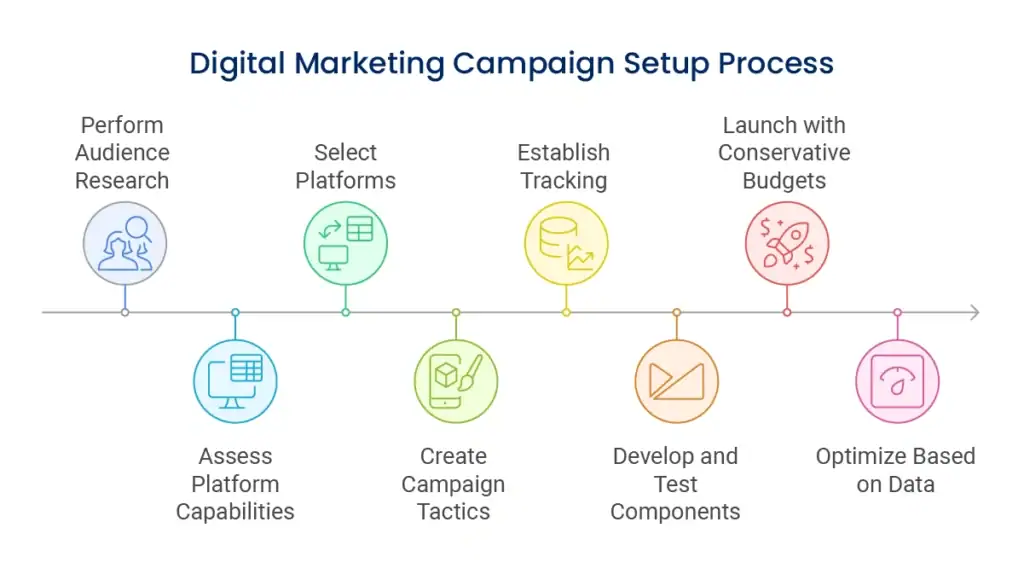
Begin by tracing your target customer’s online behavioural patterns. Where do they hang out online? What content do they interact with? When are they most online? Leverage your current customer data, survey your audience, and study competitive activity to create in-depth audience profiles.
Study the platforms your target audience uses most and learn their behavior on each platform. An individual may use LinkedIn for business research but Instagram for fun and discovery. Each of these mentalities demands different tactics.
Each platform has varying targeting capabilities, ad units, and pricing structures. Develop a comparison matrix that tests each platform against your particular requirements and budget limitations.
Consider both obvious costs like click prices and hidden costs like creative development requirements. Video-heavy platforms need more resource investment for content creation, while text-based platforms might require more copywriting expertise.
Choose one primary platform where you’ll focus 60-70% of your initial budget. This concentrated approach allows you to master the platform’s nuances and achieve profitability faster. Select 1-2 secondary platforms for testing and diversification.
Your main platform must coincide with your audience’s highest-engagement behavior and the best aspects of your business model. If you are best at visual material and your audience is younger, Instagram or TikTok could be top options. B2B businesses tend to find LinkedIn most useful as a main platform.
Every platform calls for customized tactics that honor user expectations and platform algorithms. What is successful on Facebook may not translate to LinkedIn or Google Ads. Create platform-specific strategies that take advantage of each platform’s native strengths.
Build content calendars, posting schedules, and engagement plans designed for each platform’s user behavior. Preparing in advance guarantees consistent application and improved outcomes from your campaigns.
Put in place end-to-end tracking prior to running any Paid campaigns. These encompass platform-native tracking, Google Analytics hook-up, and any custom tracking systems your company employs to capture conversions as well as customer worth.
Define explicit attribution models so you know which platforms and campaigns bring in the most valuable customers. This information will become invaluable in optimisation choice-making and budget reallocation adjustments.
Create multiple variations of your core campaign assets—headlines, descriptions, images, and calls-to-action. Design systematic tests that will identify which combinations work best with your target audience.
Begin with broader targeting to get initial performance metrics, and then refine based on what you can learn. This allows you to uncover hidden audience segments without using overly limiting targeting and reduction in reach.
Start with smaller daily budgets so you can collect performance data without incurring major losses. Most sites take 24-48 hours to optimize delivery, so don’t make too many rapid changes on the basis of early data.
Keep a close eye on the first week of Paid campaigns, looking for technical problems, unanticipated costs, or performance issues that require prompt resolution. Getting hands-on here prevents inexpensive problems from turning into costly errors.
Use the insights from your first campaign duration to make data-driven optimisation decisions. Prioritize campaigns and audience groups with the best-performing cost per acquisition and top-quality leads or customers.
Gradually raise budgets for successful campaigns while stopping or re-optimising underperforming components. This disciplined process ensures your expenditure moves towards the best-performing campaigns and media.
After your foundation campaigns are running well, these more advanced methods can make a huge difference to your performance and market edge.

Blend several targeting factors together to build extremely precise audience groups. For instance, target individuals who like your business sector who’ve also viewed competitor websites and reside in your coverage area. This layering tends to generate greatly higher conversion rates than wide-reaching targeting.
Utilize platform data on user behavior interactions to make your targeting more precise over time. Individuals who interact with your content but do not convert on the first pass could be great prospects for retargeting campaigns with varying offers or messaging strategies.
Monitor how consumers engage with your brand on various touchpoints and platforms. A consumer could find you on Instagram, look you up on Google, and ultimately convert on Facebook. Knowing these behaviors lets you better spend budget across all of your digital marketing services strategies.
Incorporate cross-device tracking methods that reveal the end-to-end customer journey. With this visibility, you’re able to provide proper credit to every touchpoint and maximize your overall marketing mix as opposed to singular campaigns in vain.
Go beyond basic A/B tests to more advanced creative testing methods. Test alternative value propositions, emotional drivers, and offers to know what resonates with your audience best.
Create customized creative extensions for various audience segments and customer journey stages. A person encountering your brand for the very first time requires different messaging compared to a person who has already seen your content several times.
Use platform automation tools to deal with repetitive optimisation tasks while you reserve your time for high-level decisions. Intelligent bidding algorithms will frequently be able to get better performance than manual bid management, particularly for accounts with good conversion data.
Establish automated rules that suspend losing campaigns, boost budgets for winners, and notify you of substantial changes in performance. This automation enables you to act promptly to opportunities and issues without ongoing manual checks.
Learning from common mistakes can spare you considerable time and money and enhance your campaign performance.
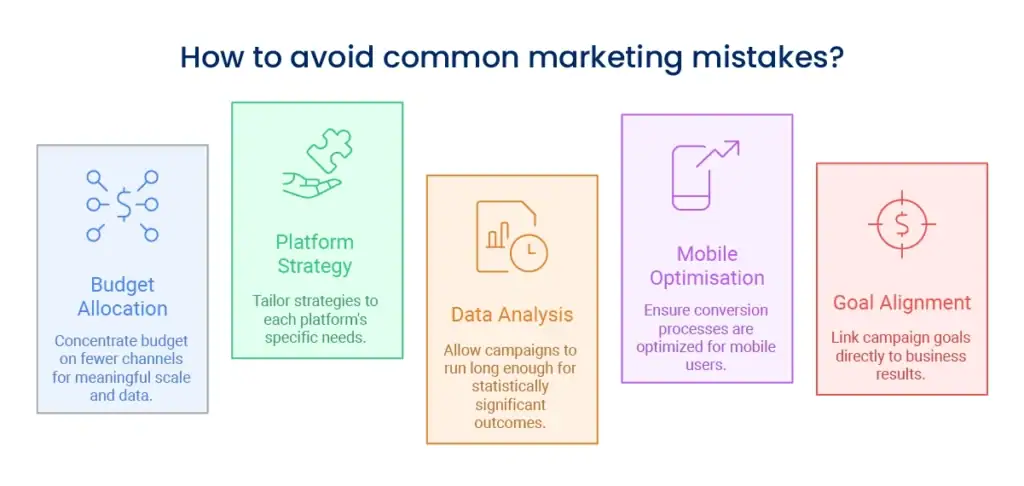
Too many companies attempt to be everywhere at once, diluting small budgets over several platforms. This process seldom creates enough data to optimise successfully and typically results in weak performance for all channels. Concentrate budget on fewer channels where you can gain meaningful scale and determine what works.
There are different algorithms, user expectations, and best practices for each platform. Following the same strategy on every platform disregards these nuances and diminishes effectiveness. Take time to learn each platform’s specific needs and optimise your strategy accordingly.
Platform algorithms must have time to optimize, and small sample data are deceptive. Don’t make drastic changes during the first 48 hours unless you recognize obvious tech issues. Allow campaigns to run long enough to produce statistically significant outcomes before making optimisation choices.
The majority of paid traffic is driven by mobile devices, but many companies fail to optimise their conversion processes and landing pages for mobile users. Make sure your whole conversion funnel is optimized for mobile devices to prevent wasting ad spend on traffic that will not convert properly.
Operating campaigns that collect cheap likes or clicks but do not lead to business expansion is a waste of resources and produces deceptive metrics. Always link campaign goals directly to business results such as sales, qualified leads, or customer acquisition that directly affect your bottom line.
Effective budget management can increase your campaign returns by 30-50% without modifying your overall strategy or creative components.

Establish daily budgets that enable platforms to spend evenly across the day instead of draining budgets early and neglecting peak conversion hours. Track spending behavior and change budgets according to when your audience is most active and will likely convert.
Employ dayparting to manage when your ads appear if your business has set hours or your audience demonstrates obvious patterns of activity. This manageability keeps waste out during slow-conversion periods while keeping sufficient funds available during high-opportunity periods.
Regularly check performance indicators and allocate budget to campaigns, audiences, and platforms with the best cost per acquisition and customer lifetime value. This adaptive allocation means your spending tracks after performance instead of predetermined assumptions.
Enforce automatic rules that stop campaigns when cost per acquisition reaches your threshold levels. This guard prevents out-of-control expenses on losing campaigns while you concentrate on scaling winners.
Analyze performance by location, age, gender, and other demographics to see which audience segments are your most profitable. Optimize targeting and spending to prioritize these high-value groups and reallocate or eliminate spend on less-performing groups.
Utilize geographic performance data to optimize local campaigns and determine opportunities for growth. You may find that surrounding cities or regions deliver high performance and indicate opportunities for geographic expansion.
Structure budget changes in line with seasonal patterns, industry cycles, and market conditions that influence your company. Spend more during peak-demand seasons and cut budgets when conversion rates usually come down.
Keep an eye on industry trends and competitor behavior that may influence your campaign performance. Economic conditions, regulatory adjustments, or significant industry incidents can all influence how well your campaigns perform and should dictate your budget distribution decisions.
Measuring the proper metrics and knowing their implications enables you to make informed decisions that enhance campaign performance and business results.
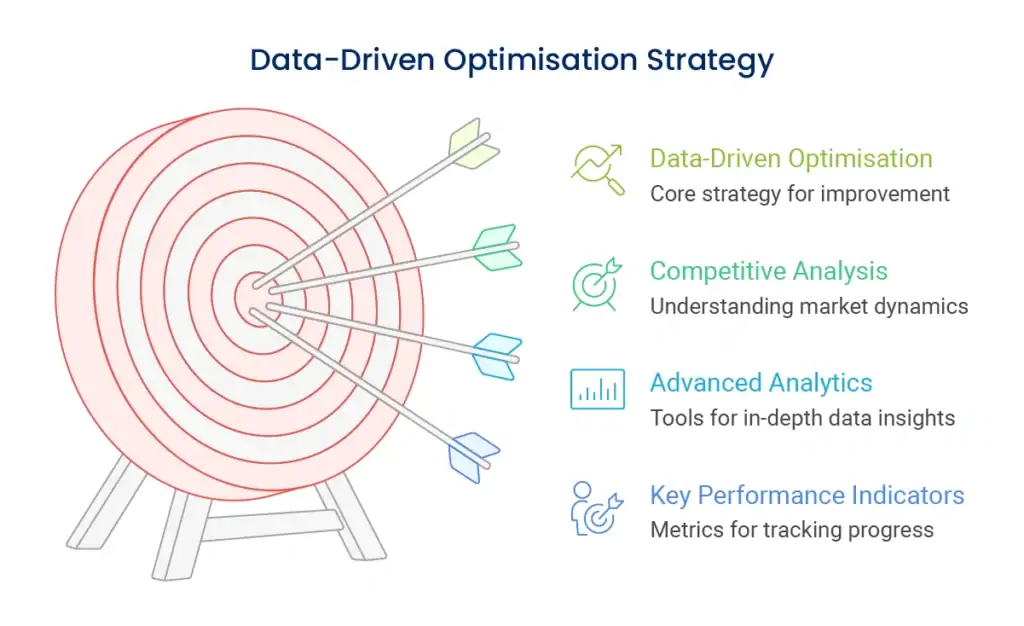
Prioritize metrics that are directly related to business goals over vanity metrics that appear to be impressive but have no bearing on growth. Monitor cost per acquisition, customer lifetime value, return on ad spend, and conversion rates by campaign and audience segment.
Implement accurate attribution tracking that takes into consideration your average sales cycle length and customer journey difficulty. B2B companies tend to require longer attribution horizons than B2C companies, and high-consideration purchases have different measurement methods than impulse purchases.
Establish regular reporting cadences that deliver actionable insights for campaign optimisation. Weekly performance reviews should highlight trends and opportunities, and monthly reports should be made to highlight strategic decisions and budget allocation changes.
Build bespoke dashboards that bring together data from all advertising platforms along with business metrics such as sales revenue and acquisition costs of customers. This end-to-end view makes you understand the full impact of advertising efforts on business growth.
Keep tabs on competitor activity and industry best practices to compare your performance to market norms. This background helps you make informed expectations and recognize areas to improve.
Leverage competitive intelligence to guide platform choice and campaign tactics. When competitors are largely committing to particular platforms or strategies, this information can determine whether to compete head-on or pursue underexploited opportunities.
Optimise based on statistically significant data and not on assumptions or short-term variance. Define minimum sample sizes and test periods that deliver sound conclusions to inform changes.
Record your optimisation decisions and the outcomes of them to create institutional knowledge as to what works for your company. This ensures you don’t replicate failed experiments and increases confidence in successful approaches.
Creating sustainable competitive advantages with paid advertising involves thinking beyond individual campaigns to build systems and capabilities that pay off in the long term.

Prioritise creating owned audiences by building email lists, social media followers, and website visitors that you can retarget with lower-cost campaigns. Owned audiences tend to convert significantly better than cold prospects and form a foundation for sustainable growth.
Map and optimize your entire customer journey from first awareness to purchase and repeat purchase. Knowing where paid advertising exists along that journey enables you to better budget and enhance overall customer acquisition efficiency.
Create systems for routinely producing high-quality creative assets that will work across many platforms and campaigns. This efficiency enables you to try more versions and adapt to shifting performance or new market opportunities.
Create content libraries by theme, audience segment, and performance level so that you can rapidly introduce proven creative components into new campaigns. This methodical process shortens creative development time while enhancing campaign performance with tried-and-true elements.
Build strong knowledge on your highest-priority platforms by keeping up with new features, algorithm updates, and best practices. This knowledge frequently brings substantial benefits as platforms roll out new targeting capabilities, ad types, or optimisation tools.
Build relationships with platform representatives who can provide insights, beta access to new features, and troubleshooting assistance when problems arise. These relationships often provide competitive advantages and faster resolution of technical issues.
Incorporate marketing technology solutions that make routine tasks automated while offering higher quality data and intelligence for strategic purposes. Customer relationship management software, marketing automation software, and sophisticated analytics tools can advance your campaign success and efficiency.
Link your advertising platforms to your sales and customer management systems to measure the full customer lifetime value and journey. It ensures the data necessary for advanced optimisation decisions and precise return on investment calculations.
Several tools can significantly improve your paid campaign effectiveness while reducing the time and effort required for management and optimisation.
Most major ad platforms offer native analytics and automated optimisation capabilities. Learn the native tools first before shelling out money for third-party solutions since they tend to give the best data and tight integration with campaign management tools.
Using tools like Google Analytics, Facebook Analytics, and specialized attribution platforms allows you to see how channels are working in combination with each other to generate conversions. These insights are vital to proper budget allocation and campaign optimization across a variety of platforms.
Creative testing platforms can assist you in methodically developing and testing ad creative alternatives. Certain platforms provide AI-driven creative optimisation that can dramatically boost performance while decreasing manual testing time and effort.
Audience research tools assist you in learning the behavior and preferences of your target audience on various platforms. Competitive intelligence tools yield insights into competitor plans and industry trends that can guide your platform choice and campaign creation decisions.
Getting paid campaign platform selection and setup right turns your ad spend from a costly gamble into a reliable growth driver. By making informed platform choices, tracking properly, and optimising using performance data, your ad expenditure turns into an investment that delivers guaranteed returns.
The companies that thrive with paid marketing aren’t always the ones with the largest budgets—but rather the ones who think about platform choice strategically, establish campaigns programmatically, and optimize from actual performance metrics instead of guesses.
Your ad success hinges on developing systems and processes that minimize waste while optimizing reach among your target customers. With a solid foundation in place, you can scale your paid campaigns with confidence that more investment will yield proportionate returns.
Creating successful paid campaigns involves skills across various platforms, strong knowledge of audience behavior, and systematic method of optimisation. Our experts specialize in assisting companies to kill ad waste and maximize conversions by strategic campaign setup strategy and continuous optimisation.
We can assist you in determining the most suitable platforms for your business, install tracking systems that offer actionable insights, and create campaigns that drive your advertising budget into tangible customer acquisition. Whether you’re deploying your first paid campaigns or optimizing existing performance, we can assist you in optimizing better results for your investment.
Begin with 10-20% of your overall ad budget for testing platforms. This keeps you from depriving your main campaign of success while you can collect relevant performance information without leaving your bottom-line performers behind. Once you find profitable new platforms, you can shift additional dollars to them while leaving your established stars intact.
Most platforms take 2-4 weeks of steady spending to deliver a stable stream of performance data. Give platform algorithms time to optimise and accumulate enough conversion data for statistical validity. Still, if you’re witnessing very high costs with zero conversions in the first week, it’s okay to slow down and check for potential issues.
Schedule budget reallocations to match your company’s seasonal cycles and past performance metrics. Spend more during peak demand and cut budgets where conversion rates historically decline. Keep an eye on performance more intently at season transition points and be ready to modify targeting or message to factor in shifting customer behaviour.
Optimise first in trial unless budgets are very high against your targets. Typical optimisation strategies include modifying targeting, creative new element testing, or bid strategy changes. Pause and redistribute budget to more improved campaigns if campaigns do not recover after 1-2 weeks of optimisation.
Enter your email to get instant access