
Custom Design
Imagine this: your dream customer browses past dozens of your competitors on the web, but when they see your brand, they instantly stop. They recognize your logo, recall your message, and most importantly—they trust you enough to click on you over all the rest. This isn’t chance; this is the power of smart brand awareness operating precisely as it’s supposed to.
Building brand awareness isn’t merely a matter of putting your name out there. It’s about making a lasting first impression that can translate into customer preference, premium pricing, and sustainable growth. When executed well, powerful brand awareness becomes your most treasured business asset—one that rivals can’t imitate and customers won’t give up.
This page will walk you through creating an overall brand awareness strategy that not only makes your brand more recognized, but makes your brand the clear choice in your market. We’ll discuss real-world frameworks for establishing trust, creating thought leadership, and creating the sort of market presence that generates both short-term sales and long-term competitive edge.

Brand awareness is the extent to which your target market knows your brand and how easily they can remember or recognize it when deciding whether to buy or not. Ultimately, brand awareness gauges if your customers think about your company when they require the goods or services that you sell.
Unlike mere name recognition, authentic brand awareness reflects multiple stages of customer familiarity. It begins with simple recognition—customers being aware your brand exists—and moves on to recall, where customers consciously consider your brand when they are making a purchase. The last stage incorporates brand preference, where customers deliberately pick your brand over the others.
From a financial perspective, robust brand recognition has a direct correlation with your bottom line. Organizations with strong brand recognition generally have higher customer lifetime value, lower marketing expenditures per acquisition, and a sense of being able to command a premium price. Studies repeatedly confirm that consumers favor brands they are familiar with 3-5 times more than unfamiliar brands, even when the quality of the product is comparable.
For expanding businesses, brand awareness is a strategic basis for every other marketing effort. If your customers already know and trust you, then your advertising works better, your content marketing leads to greater engagement, and your sales team encounters fewer objections. This creates a compounding effect whereby each marketing pound spent produces ever-better returns.
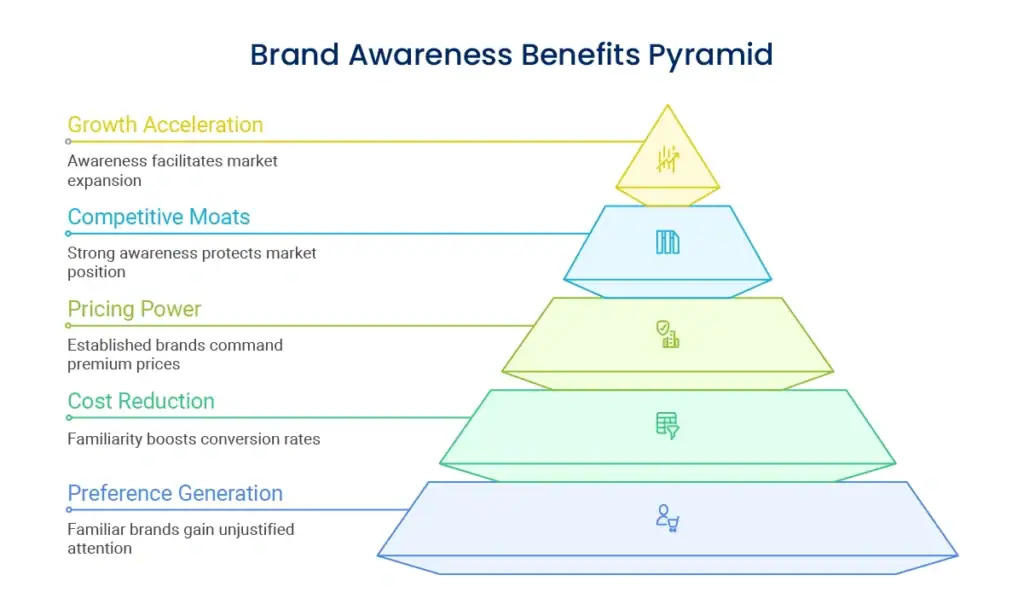
High brand recognition makes your company enter buyer consideration sets by default. While prospects look into solutions within your category, familiar brands gain unjustified attention and credibility. This preliminary advantage usually decides which companies make the shortlist and which are completely ignored.
Familiar brands invest a lot less in turning prospects into buyers. If customers are already familiar with your brand narrative and value proposition, your conversion rates rise and your sales cycles decrease. This effectiveness becomes even more important because marketing expenses keep going up on all channels.
Established brands are able to command 10-20% above competitors who are less known for alike products or services. Customers gladly pay premiums on brands they know and trust, perceiving the premium as a seal of quality and reliability and not as an overprice.
Bringing strong brand awareness makes it harder for others to take your market position. New entrants have to spend a lot to gain such comparable levels of awareness, and your existing competitors will struggle to poach customers who are emotionally attached to your brand.
Brand-conscious companies are growing more quickly since they gain larger market shares in their current markets and enter new markets more readily. Identification and credibility carry over across products and territories, offering multiple opportunities for growth from a single brand investment.

Creating enduring brand awareness involves systematic architecture that links all customer touchpoints to your fundamental brand promise. This architecture guarantees repetitive messaging through all channels while maximizing the collective power of each interaction.
Begin by charting each place where customers interact with your brand—from first discovery to post-purchase support. Every touchpoint must amplify your core brand messages as well as offer value that customers recall and transmit. This methodical process avoids fragmented messaging that gets customers confused and dilutes your awareness efforts.
Your awareness architecture must also accommodate various stages of the customer journey. Prospects at an early stage are going to require something other than customers ready to buy, and your architecture must provide right content and experiences to each audience.
Effective positioning of a brand determines just how customers should think about your brand compared to options. Good positioning provides answers to three key questions: what category you are in, how you are different, and why customers should care about being different.
Effective positioning sometimes means focusing tighter rather than wider. Businesses that attempt to be all things to all people seldom accomplish high brand recognition because their communication is not clear or memorable. Instead, position your brand to own particular characteristics or advantages that are most important to your target buyers.
Your positioning, too, should change as market circumstances and business expansion occur. What is appropriate for a startup entering a saturated market can likely require modification as you build market presence and add offerings.
Visual and verbal consistency across all touch points increases brand awareness exponentially. When customers encounter consistent colours, fonts, imagery, and messaging, they create stronger memory connections that enhance both recognition and recall.
Develop comprehensive brand identity design guidelines that cover every element of your brand expression. These guidelines should specify not just what your brand looks like, but how it should sound, feel, and behave in different situations.
Consistency is not limited to marketing communications but also extends to customer service interactions, product packaging, office spaces, and staff behavior. Each brand expression either enhances or detracts from overall awareness, so consistency becomes an enterprise-wide initiative rather than a function of marketing.

Educational content earns brand recognition by establishing your company as a credible source of industry insight. If customers repeatedly access valuable information from your brand, they form positive connections that impact future purchases.
Focus on creating content that solves real problems your customers face, even if those problems don’t directly relate to your products or services. This approach builds broader awareness while establishing your expertise across a wider range of topics.
Your educational content should also demonstrate your unique perspective and methodology. Rather than simply sharing generic industry information, show customers how you think about and approach common challenges differently than competitors.
Thought leadership involves ongoing demonstration of expertise across various channels and formats. This extends beyond blog articles to include public speaking, research in your industry, media appearances, and strategic alliances with other established authorities.
Create signature thinking, methodologies, or insights that are linked to your brand. If industry dialogue mentions your distinctive approaches or terminology, you’ve attained thought leadership that generates substantial brand awareness.
Building authority also takes persistence and patience. Thought leadership emerges from months and years of continuous expert messaging, not with one-off efforts or viral content stunts.
Having great content is useless without strategic distribution that reaches your target audience effectively. Build multi-channel distribution strategies that optimize content reach and maintain message consistency.
Think about both owned channels (your site, email list, social media presence) and earned channels (trade publications, podcasts, partner networks) when making content distribution plans. Every channel should be native to the channel and should support your brand’s core messages.
Reuse top-performing content in various formats and channels to maximize awareness effect. A single research study could be turned into a blog post, webinar, podcast guest, infographic, and social media series—each targeting varying audience segments with the same underlying message.

Deep search engine presence guarantees your customers discover your brand when they are actively looking for solutions you offer. This involves both technical optimisation and strategic content creation focusing on relevant keywords and subjects.
Make sure to capture branded and non-branded search queries. Branded searches show there is already awareness, while non-branded searches are opportunities to create new awareness among potential customers who are unaware your brand exists.
SEO company services offerings must be aligned with your wider awareness objectives instead of merely generating traffic. Search presence that brings irrelevant traffic is a waste of resources and may actually negatively affect brand perception if visitors become antagonistic due to poor experiences.
Social media sites provide special opportunities to generate awareness by direct participation and community creation. Each site demands customized strategies that are respectful of platform culture while furthering your awareness goals.
Create platform-specific content strategies highlighting various facets of your brand personality. Professional expertise could be highlighted on LinkedIn, while company culture and behind-the-scenes moments humanising your brand could be covered on Instagram.
Consistency across social sites reinforces brand familiarity while platform-specific adaptations reflect cultural sensitivity and understanding. This balance creates stronger connections with multiple segments of the audience.
Paid advertising speeds up brand awareness if targeted and messaged properly. Nevertheless, advertisements ought to supplement efforts at organic awareness instead of substituting for them, forming a series of touchpoints that reinforce your brand message.
Utilize advertising to amplify your strongest organic content and push it out to wider audiences. This ensures advertising investments reinforce overall awareness objectives while delivering quantifiable returns on investment.
Test various creative executions and messaging tactics to find out what works best with your target audience. Effective advertising campaigns tend to yield insights that enhance all other awareness efforts.
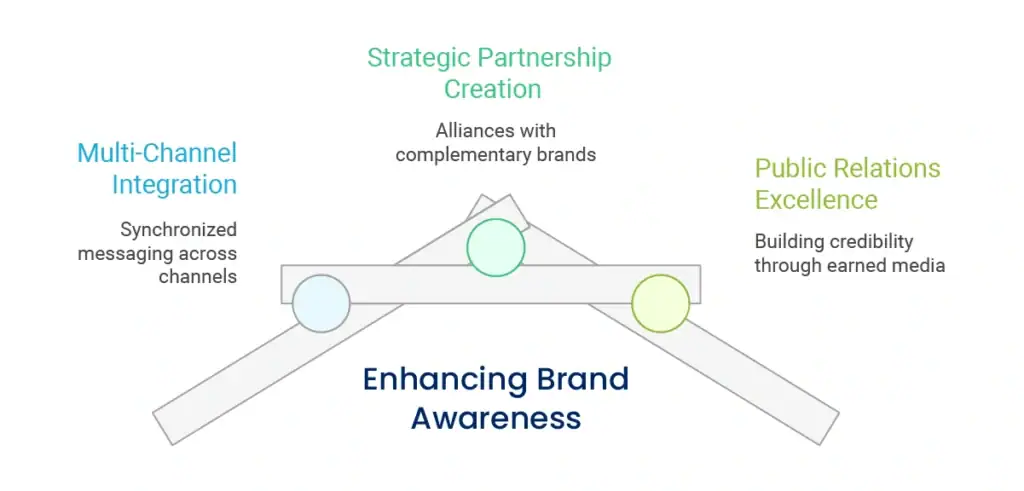
Strategic brand management involves synchronized messaging on traditional and digital channels. When customers receive consistent brand messages across multiple touch points, awareness develops faster and more intensely than single-channel methods can do.
Structure integrated campaigns that sequence channels in a strategic flow. Traditional media could generate the initial awareness, digital channels could offer detailed information, and direct interactions close the deal. Each channel should augment others while ensuring message consistency.
Take measurements across channels to learn how the different touchpoints collaborate. Customers don’t typically convert following single exposures, so it’s vital to measure how the different channels contribute to ultimate awareness and conversion objectives.
Alliances with similar or complementary brands or industry leaders can speed awareness creation by bringing your brand in front of established audiences. Select partners whose users overlap your target market but whose offerings are not in direct competition with yours.
Joint content development, co-promotion, and co-events generate win-win situations for both brands that deliver value to common audiences while winning both brands. Joint ventures typically deliver more reach and credibility than separate efforts.
Relationships of long-term partnership are more valuable than single experiences. Creating recurring relationships with strategic partners generates regular awareness touchpoints while establishing industry relationships that assist in larger business objectives.
Strategic public relations creates brand recognition via earned media placements that are more credible than paid advertising. Target newsworthy stories that link your brand to wider industry movements or social concerns of importance to your target audience.
Establish connections with journalists, bloggers, and industry thought leaders who write about your industry. These relationships take time to establish but lead to consistent opportunities for brand visibility through credible third-party endorsements.
Crisis readiness also comes in handy in safeguarding brand recognition. Businesses that manage crises openly and with accountability tend to have better brand recognition and trust levels after the crisis than they had prior to the crisis.

Each customer touchpoint builds or destroys brand awareness. Great experiences foster positive impressions that customers remember and repeat, while negative experiences can destroy awareness and perception in an instant.
Plot end-to-end customer journeys to map out all touchpoints where brand experiences take place. Focus closely on moments of truth—high-stakes interactions disproportionately affecting customer perceptions and loyalty.
Create experiences that deliver your brand values and positioning. If simplicity is what your brand promises, make all interactions with customers simple. If personal service is your brand mantra, empower staff to deliver beyond customer expectations every time.
Brand trust is built through ongoing demonstration of competence, dependability, and care for customers’ success. This involves transparency of both strengths and weaknesses, demonstrating to customers that your brand cares more about honesty than hype.
Post behind-the-scenes materials that reveal how your company functions and makes choices. Being open helps customers know your brand’s values and build emotional relationships that enhance awareness and loyalty.
Publicly address customer issues and grievances when the situation calls for it. Firms that deal with issues openly tend to establish stronger trust than firms that never experience issues because they prove their willingness to serve customers.
Strong communities reinforce brand awareness by word-of-mouth and peer endorsement. Develop communities along values, interests, or challenges rather than on your products or services alone.
Deliver community value in the forms of education, networking, and peer assistance rather than mere promotional messaging. Value-based communities are generally more active and loyal compared to sales-driven ones.
Invite user-generated content and customer testimonials that reveal actual experiences with your brand. Customer voices are more credible than corporate communication and yield new content that keeps the community engaged.

Quantitative measures and qualitative observations are both necessary to measure brand awareness, which as a whole offers an entire picture of brand recognition and perception. Conventional surveys are still useful for gauging aided and unaided recall of the brand, while digital analytics uncover behavioural signals of awareness intensity.
Monitor direct website traffic, branded search volume, and social media mentions as measures of increasing brand awareness. These metrics indicate when customers actively look for your brand instead of merely reacting to advertising or promotions.
Analytics and reporting must link awareness metrics to business impact such as lead quality, conversion rates, and customer lifetime value. This link serves to justify awareness investments and determine what activities produce the highest business impacts.
Recurring customer feedback shows how your brand awareness initiatives affect actual perceptions and tastes. Implement structured feedback gathering that looks beyond satisfaction levels to also examine brand associations and competitive comparisons.
Leverage feedback to spot gaps between brand positioning intentions and customer realities. These gaps point to opportunities to reinforce messaging or enhance experience that will drive awareness objectives.
Pass on positive feedback experiences throughout your company to remind everyone of the significance of brand awareness initiatives. As teams understand how brand visibility affects customer relationships and business results, they are more inclined to support awareness objectives.
Keep an eye on competitor awareness campaigns to scan for market opportunities and for threats to your brand position. This analysis needs to include both direct competitors and secondary brands that could impact customer perception or preference.
Monitor competitor content strategies, ad campaigns, and partnership formations to see their awareness building strategies. With this information, identify market space gaps your brand may fill.
Ongoing competitive monitoring also prepares you for market change that may necessitate awareness strategy tweaking. Being ahead of competitive action facilitates proactive as opposed to reactive brand management.
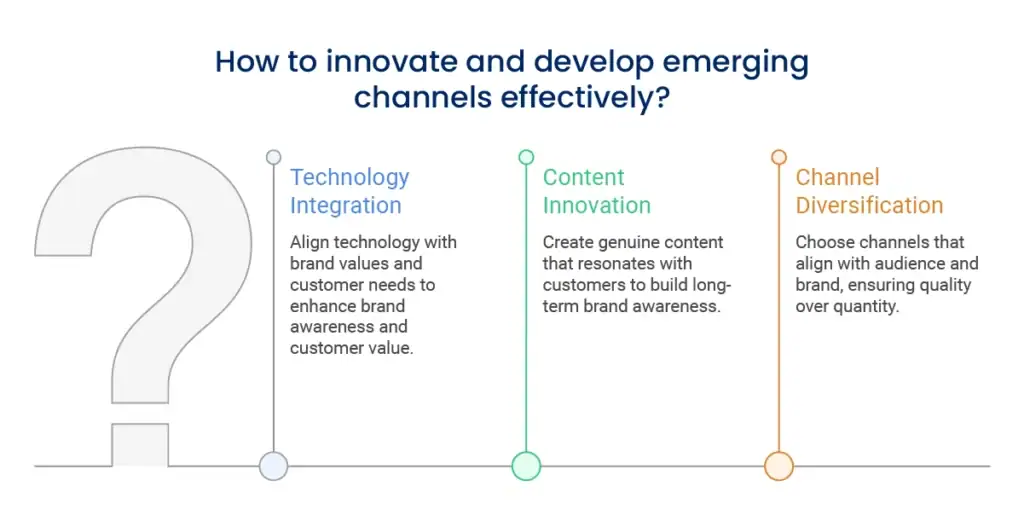
New technologies provide new avenues for creating brand awareness via new customer experiences and innovative service offerings. Technology adoption must, however, be aligned with the values of the brand and needs of customers and not driven by innovation for its own sake.
Assess new technologies in terms of their ability to reinforce brand awareness while enabling real customer value. Early technology adoption may create competitive advantage, but unsuccessful technology integration may destroy brand perception.
Pilot new technology at small levels prior to full scale. This process permits learning and refinement while keeping risks at a minimum against larger brand awareness efforts.
New content forms and delivery formats have the power to cut through saturated markets and get noticed by customers. Try new formats such as interactive content, immersive experiences, and personal communications that reflect your brand personality.
Innovation must be genuine to your brand and not trend-chasing for the sake of it. Customers immediately identify and reject insincere efforts to look cutting-edge or trendy.
Judge innovation success by the quality of engagement, not just reach or volume. Content that builds resonance drives long-term awareness objectives better than viral content building fleeting attention.
New channels of communication pop up all the time, offering means to engage consumers in new ways. Assess new channels for audience alignment, message suitability, and resource fit as opposed to novelty or popularity.
Begin with pilot programs to experiment with channel performance before expending large amounts of resources. Certain channels that perform effectively for some brands will not be appropriate for your audience or business model.
Prioritize quality standards across every channel instead of compromising brand consistency for wide reach. It is preferable to shine on fewer channels than to offer average experiences on numerous touchpoints.

Brand equity is the sum of all perception and awareness efforts over a period of time. High brand equity can support premium prices, customer loyalty, and expansion into new markets and shield against competitive attack and market declines.
Build equity by delivering consistent value that surpasses expectations. Every favorable brand encounter adds to equity building, while every negative experience can destroy years of equity building in an instant.
Brand equity also carries over across product categories and market segments, thus becoming an asset to expand the business. Strong brand equity companies find it easier to enter new markets since customers transfer established trust to new products.
Brand awareness builds enduring competitive advantages that are hard to imitate by competitors swiftly. Although imitations of products, services, or promotional methods by competitors are possible, it is not easy for them to imitate the trust developed and recognition built through time by strong brands.
Defend competitive assets by continually reinforcing brand connections and customer relationships. This involves constant investment in awareness efforts even during good business, as brand momentum is lost faster than it’s gained.
Brand positioning strategy must shift with market realities while upholding core brand values. Effective brands modify their expression and focus while holding onto the key attributes fueling customer preference.
Think beyond short-term business objectives to think about the long-term legacy your brand will leave behind. Successful brands endure beyond founders and individual leaders and become institutions that customers trust over generations.
Write down your brand story, values, and decision-making models to maintain consistency as your company develops and changes. Writing them down will enable new members of staff to comprehend and maintain brand essence as they accommodate new circumstances.
Think about the ways that your brand adds to overall social and economic value that transcends mere profit creation. Positive social-impact brands tend to have greater awareness and loyalty along with securing a more desirable employee base and partners.

Strong brand awareness requires organisation-wide commitment to brand values and consistent customer experiences. This means hiring, training, and managing teams in ways that support brand objectives rather than just operational efficiency.
Develop training programs that help all employees understand their role in building brand awareness and delivering on brand promises. Customer-facing employees particularly need deep brand knowledge that enables them to represent the brand consistently and authentically.
Recognise and reward behaviours that strengthen brand awareness while addressing actions that might damage brand perception. This reinforcement helps embed brand thinking into daily operations rather than treating it as a separate marketing function.
Business leaders play crucial roles in building brand awareness through their personal actions and communications. Leaders who authentically embody brand values become powerful advocates who amplify awareness efforts through their networks and industry presence.
Train leadership teams to communicate brand messages consistently while maintaining their individual personalities and communication styles. This balance creates authentic advocacy that feels genuine rather than scripted or artificial.
Encourage leaders to participate in industry events, media interviews, and thought leadership opportunities that showcase brand expertise while building personal profiles that support overall awareness goals.
Empower employees to contribute to brand awareness through their professional networks and social media presence. Provide guidelines and resources that help team members share brand content and messages appropriately while maintaining professional credibility.
Create internal communication systems that keep teams informed about brand initiatives, achievements, and goals. When employees understand and celebrate brand successes, they become more committed advocates who support awareness building through their daily interactions.
Recognise that every employee interaction with customers, suppliers, partners, and industry contacts either builds or diminishes brand awareness. Training and empowering teams to represent the brand positively in all professional interactions multiplies awareness building efforts significantly.
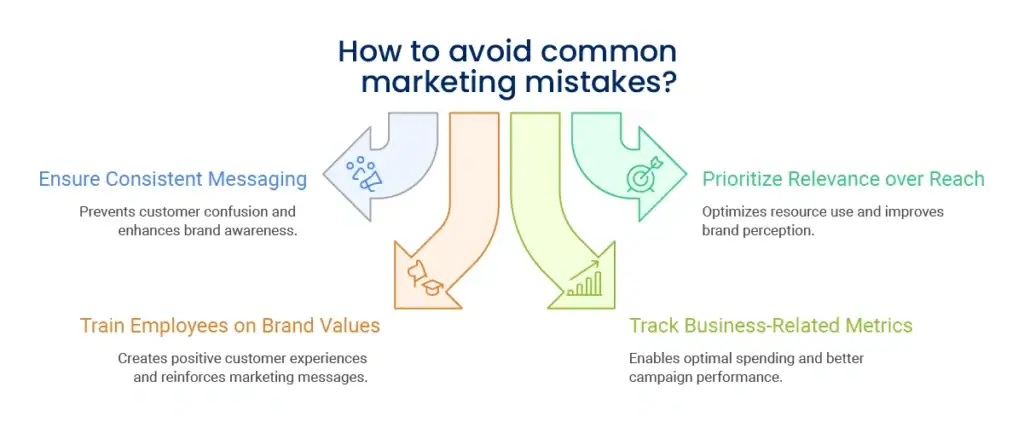
Confused messages by customers diminish overall brand awareness irrespective of campaign individual quality .
Visibility in front of the wrong people wastefully expends resources and compromises brand perception
Customer-facing staff who are unaware of brand values tend to create experiences that negate marketing messages
Monitoring likes, shares, and impressions without linking to business results renders it impossible to optimise awareness spend optimally
Brand awareness isn’t marketing—it’s a strategic business asset that drives all dimensions of company performance. When customers understand, recognize, and believe in your brand, you build pricing power, competitive defense, and expansion opportunity that alters business courses.
The companies that invest methodically in creating brand awareness and measuring and optimizing their efforts build compounding strengths that become more potent as time goes by. This strategic effort makes brand recognition translate into customer preference, market domination, and long-term business growth that competitors are unable to replicate.
Establishing strong brand awareness takes patience, consistency, and forward thinking that goes well beyond specific campaigns or tactical efforts. But for companies dedicated to long-term success, there’s no more worthwhile investment than building a brand that consumers find and seek out, recall with affection, and recommend with passion.
Creating overall brand awareness necessitates experience in a range of disciplines from strategic positioning to content marketing implementation. Our specialists are experienced in creating integrated awareness strategies that drive quantifiable outcomes while establishing enduring competitive differentiation.
Brand awareness normally grows within 12-24 months of steady effort, though early recognition may happen within 3-6 months. The duration varies with market competition, budget allotment, and a consistent message across all touchpoints.
Brand recognition happens when consumers recognize your brand when they see it, whereas brand awareness encompasses unprompted recall—consumers remembering your brand when they require your kind of product or service. Awareness is more profound mental availability than if just recognition existed.
Most successful businesses allocate 15-25% of their marketing budget specifically to brand awareness activities. However, this varies significantly based on business stage, market competition, and growth objectives. Newer businesses often need higher percentages to establish market presence.
Enter your email to get instant access