
Custom Design
Imagine you’re in a busy marketplace where dozens of companies provide comparable products or services. What drives customers to prefer one brand over another? The key is strategic brand positioning – the science and art of building a unique, memorable position in your customers’ minds.
Strategic brand positioning is not about coming up with a memorable tagline or flashy logo. It’s about knowing your target audience inside and out so you can articulate your differentiator in terms that speak to their hearts as well as their minds. Done correctly, it turns your company into more than just a choice, but the clear choice.
This in-depth guide will take you through all that you must know about strategic brand positioning, from the fundamentals of learning what it is all about to applying practical tactics that translate into tangible business outcomes.

Strategic brand positioning is the conscious act of creating a distinctive, valuable, and memorable position for your brand in the minds of your target market. It is like staking out your own piece of ground in the expansive topography of consumer awareness.
At its core, brand positioning defines three basic questions: Who are you? What do you believe in? Why do customers need you rather than anyone else? Your brand positioning strategy then serves as the basis for all marketing choices, from your visual identity to your customer service style.
The “strategic” component implies this isn’t by chance or happenstance. It’s a strategically conceived strategy based on diligent competitive research, intimate knowledge of your target market, and crisp definition of your unique selling proposition. If your positioning strategy conforms to customer requirements and market conditions, it generates sustainable competitive advantage that others can’t easily imitate.
Strategic brand positioning is effective because it leverages the way human minds work. We automatically group and compare items in order to make selections simpler. By mapping your position clearly, you make your customers aware of precisely where you are in their cognitive scheme, so they’ll be more likely to pick you when they need it.

Getting your brand positioning correct can be the difference between fighting for attention and emerging as a market leader. Here’s why it’s downright imperative to your business success:
Develops Unambiguous Market Distinction When you place your brand in a strategic position, you no longer compete on the price or features alone. You instead compete on how you offer distinct value to consumers’ lives. This distinction allows customers to see why they need to use you, even when confronted with similar substitutes.
Creates More Powerful Customer Relationships Strategic positioning enables you to reach your target audience at an emotional level. Once your customers view your brand as knowing their particular needs and challenges, they form loyalty that transcends transactional relationships.
Guides Decision Making Consistently A positioning strategy clarified is your business decision North Star. Whether you’re introducing new products, developing marketing communications, or educating your staff, your brand positioning keeps everything in alignment with your core identity and value proposition.
Increased Pricing Power Brands with strong position have the power to charge premium prices since customers see distinctive value. If you’re the expert, the innovator, or the trusted choice in your category, individuals will pay more for what you’re offering.
Pulls in the Right Customers Strategic positioning is a magnet for your target customers and excludes those who are not right for you. This results in increased customer satisfaction, higher lifetime value, and more effective marketing dollars.
Creates Brand Resilience Strong positioning places a moat of protection around your company. When customers easily get and appreciate what sets you apart, they’re not as likely to jump to rivals, even in tough times.
Knowing the building blocks of strategic brand positioning enables you to develop a strategy that really speaks to your market. So let’s take a look at the key elements that combine to create effective positioning.

Your positioning will begin with crystal-clear knowledge of whom you are attempting to reach. This extends far beyond demographics to encompass psychographics, behaviour, pain points, and aspirations. The more narrowly you can define your target audience, the more accurately you can position your brand to resonate with them.
Successful audience definition means developing rich buyer personas that reflect your dream customers. These personas need to encapsulate not only who they are, but how they perceive the world, what they believe, and what drives their buying behaviors. As you know your audience this intimately, your brand positioning becomes ever more pertinent and persuasive.
You can’t position your brand without knowing the competitive landscape. This involves identifying both your direct and indirect competitors, examining their positioning strategies, and discovering your opportunities for differentiation.
The objective isn’t to mimic what competitors are doing, but to appreciate where gaps in the market exist. In some cases, the strongest positioning can be found in zigging while others are zagging. By fully mapping the competition, you can find white space where your brand can carve out distinct territory.
Your unique selling proposition is the core of your positioning strategy. It’s the specific benefit or unique advantage that only your brand can credibly assert. This’s not merely a matter of what you do differently, but of the value this difference brings to customers that no other does.
A solid value proposition is clear, relevant, and hard for competitors to replicate. It must be rooted in actual strengths and abilities, not marketing hype. When customers can precisely explain how your brand is distinct and why that distinction is significant to them, you’ve effectively conveyed your value proposition.
How you talk is as crucial as what you say. Brand personality is the human qualities you desire to attach to your brand, and voice is the exact tone and language of your communications.
Your personality should match your target audience’s liking and positioning strategy. If you’re positioning as the trusted, dependable option, your personality can be professional and reassuring. If you’re the innovative disruptor, your personality can be bold and challenging.
Individuals decide with their hearts and rationalize with logic. Strategic brand positioning leverages the emotional drivers that drive your target market. This could be the need for safety, the urge for prestige, the fear of being left behind, or the desire for personal betterment.
Knowing the emotional terrain of your marketplace enables you to position your brand not only as fixing practical issues, but fulfilling inner emotional needs. Brands that excel at emotional connection build the most powerful customer loyalty and advocacy.
Crafting successful brand positioning involves a structured process from research through strategy to implementation. Here’s how to craft positioning that really speaks to your market.

Begin by gathering in-depth information about your market, customers, and competition. This research phase is important because positioning that is effective has to be based on market facts, not hopes or assumptions.
Use surveys, interviews, and focus groups to understand your target audience’s needs, preferences, and current perceptions of your brand and competitors. Look for patterns in their language, values, and decision-making processes. Pay special attention to unmet needs or frustrations that represent positioning opportunities.
Complete customer research with competitive intelligence. Examine competitors’ messaging, positioning statements, visual identity, and customer feedback. Search for gaps in their positioning that you can fill, or areas where you can rightfully claim to be superior.
Based on your research, define clearly the specific audience segments you wish to target. Keep in mind, attempting to appeal to everyone typically means appealing to no one adequately.
Develop in-depth personas for each of your target segments, including demographics, psychographics, behavior, goals, challenges, and preferred communication channels. Knowing not only who your customers are, but how they feel and think, allows for more accurate positioning.
Think about both primary and secondary audiences. Your primary audience informs the core positioning strategy, while secondary audiences may impact particular messaging or channel strategies within that positioning strategy.
Honestly assess your brand’s strengths, capabilities, and unique assets. What can you do better than anyone else? What do you offer that competitors can’t or don’t? This analysis should be brutally honest – positioning built on fictional advantages won’t survive market scrutiny.
Seek benefits across several dimensions: product attributes, service quality, company culture, brand storytelling, price, distribution, or customer experience. In some cases, the strongest positioning results from taking several smaller benefits and weaving them into an innovative overall proposition.
Identify both rational and emotional benefits. Rational benefits are factual, quantifiable gains, whereas emotional benefits concern the emotional responses customers experience with your brand. The most robust positioning tends to blend both.
Your positioning statement is a concise, clear description of your brand’s distinctive position in the market. It must conform to this simple template: “For [target audience], [brand name] is the [category] that [key benefit] because [reason to believe].
“Example: “For parents with jobs, MealPlan Pro is the meal planning service that takes dinner stress away because we offer customized, healthy meal plans with automated shopping lists and 15-minute prep recipes.”Your positioning statement becomes the basis for all marketing communications and business decisions. Test it with actual customers to make sure that it resonates and separates your brand well.
Develop the support pieces that bring your positioning to life. These are your brand personality, voice and tone guidelines, visual identity direction, and key messaging themes.
Make sure that all these components of your marketing mix support and reinforce your core positioning. If, for example, you are positioned as the premium, sophisticated option, everything from your colour scheme to your customer service style should mirror this positioning throughout.
Think through how your positioning shifts between various touchpoints and stages of the customer journey. Your positioning needs to be clear when customers experience you via social media marketing, your website, customer service interactions, or product packaging.
Test your positioning with your target audience before fully engaging in it. This may include concept testing, message testing, or pilot market tests for gauging response and effectiveness.
Seek indicators that your positioning is effective: greater brand awareness, better brand perception scores, improved conversion rates, or enhanced customer retention. If the outcomes are not reaching expectations, be ready to make adjustments.
Keep in mind that positioning is not permanent. Markets change, competitors shift, and customer requirements develop. Periodically examine and revise your positioning to keep it fresh and engaging.
Effective positioning necessitates consistent execution at every customer touchpoint. This involves integrating your digital marketing strategies, selling processes, customer care, product innovation, and even company culture into your positioning.
Develop guidelines and training content to ensure your team understands and consistently applies your positioning strategy. When your entire organisation knows and lives your brand positioning, it becomes a lot more credible and compelling in the market.
Regularly check implementation to maintain consistency. Small differences from your positioning will confuse customers and dilute your market position over time.
Create metrics to measure the success of your positioning strategy. These could be brand awareness metrics, perception studies, market share results, customer acquisition costs, or measurements of customer lifetime value.
Analyze data and feedback from customers to continually hone your positioning. Search for ways to reinforce your position or expand it into new territories as your business expands and market conditions evolve.
Keep in mind that effective brand positioning is a long-term process, not a short-term project. The best brands consistently revise their positioning while keeping core consistency and differentiation.
Make judgments regarding how design trends, shifts in your business emphasis, or changes in your customers could impact future revisions to your visual brand assets.
The business environment keeps on developing rapidly, and there is a need for more advanced methods of brand positioning. The following are innovative strategies that progressive brands employ to ensure competitive edge.
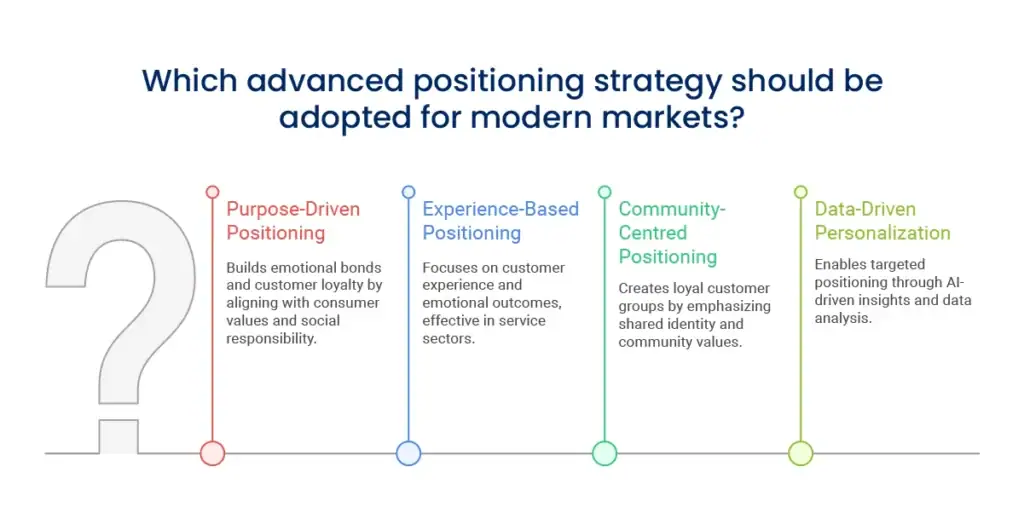
Purpose-Driven Positioning Today’s consumers, particularly younger generations, more and more decide on brands based on values and social responsibility. Purpose-driven positioning transcends product value to articulate how your brand contributes to the world becoming a better place.
This method demands sincere dedication to your declared purpose. Customers can quickly recognize and dismiss shallow pursuit of purposeful marketing. In its true form, though, purposeful positioning creates extremely powerful emotional bonds and customer loyalty.
Experience-Based Positioning In contrast to the fixation on product features, experience-based positioning centers around the end-to-end customer experience and emotional outcomes. This method acknowledges that customers don’t merely purchase products – they purchase experiences, emotions, and changes.
Experience-based positioning demands supremacy at every customer touchpoint, from initial awareness to after-purchase support. It’s especially effective in service sectors or when products are commoditised across competitors.
Community-Centred Positioning Certain brands define themselves as the centre of a movement or community. This positioning focuses on belonging, shared identity, and common values more than personal benefits.
Community-focused positioning is effective when your audience has strong common interests or values. It involves constant commitment to community creation and participation, but can produce extremely loyal customer groups that champion your brand themselves.
Data-Driven Personalization Leading brands leverage AI-driven insights and data analysis to develop highly personalised positioning for various customer segments. This method enables you to preserve core brand consistency while customising specific positioning aspects to appeal to various groups of audiences.
Such a strategy demands advanced data gathering and analysis capacity, but permits much more targeted and effective positioning compared to one-size-fits-all strategies.
Even well-intentioned positioning efforts can fail if they fall into common traps. Understanding these pitfalls helps you develop stronger, more effective positioning strategies.

Try to be everything to everyone Every attempt at positioning goes wrong when the organisation tries to appeal to an audience too broad. When you try to be everything to everyone, you become nothing special to anyone. Strong positioning requires that a firm makes choices about who it will serve and how it will serve them.
Prioritize being extraordinarily pertinent to one group of people over moderately interesting to all. You can always extend positioning later as your brand matures and expands.
Imitating Competitor Positioning Emulating successful competitors may be comfortable, but it seldom equates to robust market position. If you position your brand similarly as successful competitors, customers lack a good reason to select you over them.
Search for white space in the marketplace where you can stake out distinctive ground. The most compelling positioning sometimes arises from taking on conventional industry thinking or targeting unpenetrated market niches.
Denying Market Reality Positioning needs to be based on actual market realities and customer desires. Positioning by internal assumption or fantasy tends not to succeed in actual markets.
Invest in thorough market research and customer insights before finalising your positioning strategy. Test your positioning concepts with real customers to ensure they resonate and differentiate effectively.
Inconsistent Implementation Even brilliant positioning strategies fail if they’re not implemented consistently across all touchpoints. Mixed messages confuse customers and weaken your market position.
Develop clear guidelines and training programs that ensure every participant in your organisation understands and consistently implements your positioning strategy. Regular monitoring and feedback help in maintaining such consistency over time.
Successful measurement lets you know if your positioning is effective and where it may be improved. The following are some of the most important metrics and methods for measuring positioning success.
Brand Awareness and Recognition Monitor aided and unaided brand awareness among your target consumers. Successful positioning should result in higher awareness and more accessible brand recognition over time.
Track category share of voice and monitor your relative brand awareness versus the leading competitors. Watch for trends that suggest increasing market presence and mindshare.
Brand Perception Studies Periodic perception studies inform you about what your target audience thinks about your brand compared to the competition. These studies need to track both rational and emotional attributes.
Monitor whether customer perceptions match your desired positioning. Areas of gap between intended and perceived positioning are where implementation or communication needs to change.
Customer Acquisition and Retention Metrics Strong positioning must make customer acquisition more effective and enhance customer retention levels. Monitor measurements such as customer acquisition cost, conversion rates, and customer lifetime value.
Monitor for evidence that your positioning is pulling in higher-quality customers who are more likely to be loyal and refer others to your brand.
Customer Acquisition and Retention Metrics Strong positioning must make customer acquisition more effective and enhance customer retention levels. Monitor measurements such as customer acquisition cost, conversion rates, and customer lifetime value.
Monitor for evidence that your positioning is pulling in higher-quality customers who are more likely to be loyal and refer others to your brand.
Market Share and Competitive Performance Track your market share trends and competitive position over time. Sound positioning should enable you to gain share or at least hold a position in competitive markets.
Monitor win/loss ratios in competitive contexts and learn why customers select you or opponents. This data assists in sharpening your positioning and competitive strategy.
Creating strong brand positioning calls for profound knowledge of the market, strategic insights, and meticulous execution through all channels. Although the frameworks and strategies presented here are solid, a number of businesses find it useful to be advised by professionals to guide them through the intricacies of today’s market positioning.
If you want to fortify the market standing of your brand or create positioning for a startup, then collaborate with seasoned brand strategy professionals who can give you unbiased opinions and time-tested approaches suited to your particular context.
Strategic brand positioning is perhaps the strongest means of creating sustainable competitive advantage and long-term business success. When you have a firm grasp of who your target market is, are able to differentiate your brand in a meaningful way, and communicate your distinctive value consistently, you lay the groundwork for enduring market leadership.
Keep in mind that great positioning isn’t about being best at all – it’s about being uniquely valuable to the right customer. By using the frameworks and strategies laid out here, you can create positioning that not only differentiates your brand but creates deep emotional connections with customers who become your most vocal advocates.
The investment in strategic brand positioning pays dividends across every aspect of your business, from more efficient marketing and higher conversion rates to increased customer loyalty and premium pricing power. Start with thorough research, be honest about your unique strengths, and commit to consistent implementation across all touchpoints.
Your brand positioning is your vow to the marketplace regarding the differentiated value that you bring. Make it straightforward, make it exciting, and most fundamentally, make it authentic to who you are and what you can genuinely do better than anybody else.
Enter your email to get instant access