
Custom Design
Imagine this: you’ve just unleashed what you believed was a genius marketing campaign, only to see it flop with little action and lackluster returns. Ring a bell? Most business owners struggle with this because they miss the key building block—sound Campaign strategy and development.
Campaign strategy is not merely a matter of designing attention-grabbing ads or publishing content on multiple platforms. It’s about developing a disciplined system that bridges your brand message to the appropriate people at the right time, producing campaigns that do more than grab attention – they drive significant business growth.
This site will guide you through all you must learn in order to create effective campaign strategies, from comprehending fundamentals to applying usable frameworks that turn your marketing campaigns into quantifiable success stories.


Campaign strategy and planning is the orderly process of developing, conceiving, and implementing integrated marketing tactics to fulfill predetermined business goals. Consider it your marketing roadmap—a comprehensive guide that directs every choice from idea inception to ultimate performance evaluation.
In contrast to random marketing activity, deliberate campaigns weave together several touchpoints and channels to deliver integrated brand experiences. Each piece works in concert: your messaging supports your point of difference, your creative assets are aligned with your brand identity, and your distribution channels intersect with your target audience where they’re most open to receiving it.
The development stage bridges strategic thinking and doable campaigns. This involves creating effective content creation processes, building strong ad creatives, creating appropriate budget allocation processes, and implementing strong performance tracking systems that monitor effective key performance indicators.

Campaign strategy creation is not a choice in today’s competitive market—it’s necessary for long-term growth. Companies that invest in effective campaign strategy perform much better than companies that use ad-hoc marketing efforts.
Effective campaigns craft compound value that touches far more than immediate purchase. They forge persistent brand recognition, create repeatable customer touchpoints along the customer lifecycle, and amass valuable data insights to guide future marketing initiatives. This structured process allows you to know what communications resonate with your viewers and what media gives you the greatest return on investment.
Strategic campaigns also save your marketing budget from being squandered. Instead of casting resources over several unrelated activities, concentrated campaign creation channels your efforts where they’ll make the biggest difference. You’ll notice better lead generation, deeper customer connection, and more sustainable revenue growth.
Most crucially, strategic campaigns establish your brand as a considered, competent presence within your market. Clarity of messaging and aligned execution foster trust among potential customers, increasing the chances that they’ll turn to your business when they’re ready to make a purchase.

Effective campaigns begin with a thorough understanding of your market environment and customer behavior. This extends beyond simple demographics to encompass psychographic factors, purchasing habits, and pain points that guide the purchase decision. Market research uncovers competitive space you can capitalize on and reveals latent audience segments you should target. Once you know how your target audience segmentation is divided, you can create messages that address the unique needs and motivations of each segment directly.
Your message for the campaign needs to explicitly state how your customers should prefer your brand over others. This involves creating a strong unique selling proposition that makes your product or service stand out uniquely. Successful messaging frameworks solve customer issues, introduce your solution, and provide concrete benefits. The best campaigns combine emotional appeals with rational arguments, so your messages both touch hearts and get the logic right for the purchase decision.
Today's customers engage with brands through numerous touchpoints before they make a purchase. Your campaign approach needs to address this multifaceted customer journey by synchronizing messages on all the appropriate channels. Multi-channel marketing isn't about everywhere—it's about being somewhere where your audience hangs out and making certain consistent brand experiences at every single touchpoint. This builds the omnichannel experience that establishes trust and leads prospects directly and effortlessly to conversion.
Your campaign creative assets must collaborate with each other to support your strategic messaging along with grabbing attention in ever more congested digital channels. This ranges from ad creatives and social media posts to email flows and landing page layouts. Content creation must complement various points throughout the customer journey, presenting the prospect with the correct information at the correct time in order to advance prospects. Short-form video content, interactive content, and personalized messaging all have key roles to play in campaign development today.
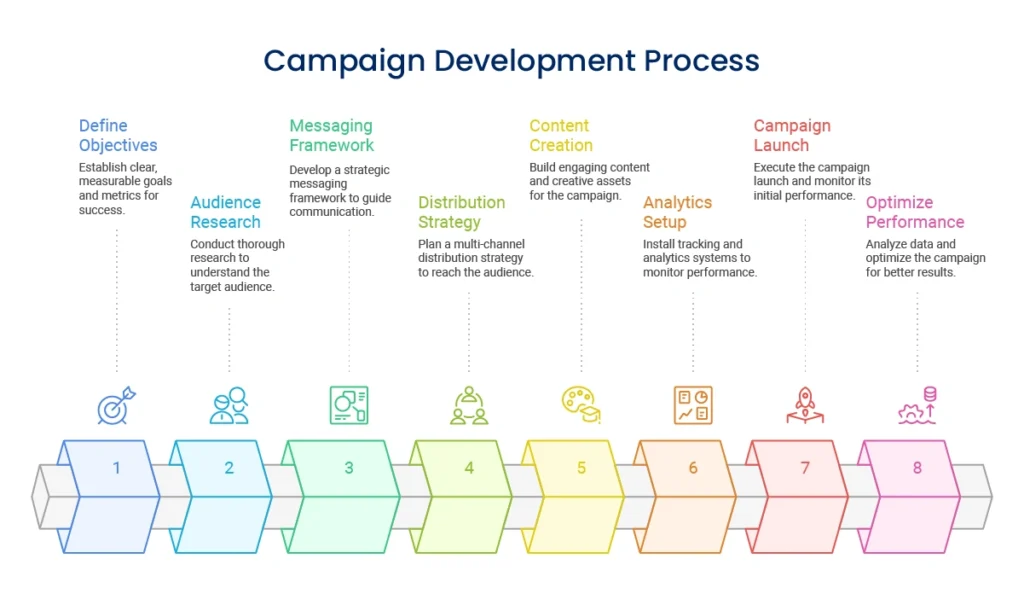
Begin by establishing clear, measurable goals that align with your broader business objectives. Whether you’re focused on brand awareness, lead generation, or direct sales, campaign goals should be concrete enough to guide every subsequent decision.
Map out your key performance indicators in advance, both your main metrics such as conversion rates and secondary metrics such as engagement rates or brand mention increases. The clarity avoids scope creep and means everyone knows what a successful outcome is.
Immerse yourself in your target audience with both quantitative insights and qualitative research. Analyze existing customer information, survey or interview existing customers, and explore competitor audience demographics to create rich buyer personas.
Be very focused on customer journey mapping—how your audience makes their way from awareness to consideration to purchase. This information guides channel and timing decisions throughout your Campaign strategy process.
Develop a messaging structure that begins at your central value proposition and then stems off into targeted messages for distinct audience groups and campaign stages. Your messaging should speak to important customer pain points as well as make the most of your differential benefits.
Test your messaging ideas with actual audience members prior to full campaign launch. Quick message testing can point out which methods strike strongest and assist you in sharpening your communications approach.
Overlay your selected channels with your audience research and customer journey insights. Think about where your audience hangs out, what channels support your ideal content formats, and how various platforms can complement each other to steer prospects toward conversion.
Channel budgets should be balanced with both audience preference and historical performance in mind. Don’t dilute resources across too many channels—it’s more effective to shine on fewer channels than to be average everywhere.
Build content that aligns with your strategic goals while naturally fitting within each selected platform. Your creative assets should be consistent in brand identity but comply with platform nuances and audience demands.
Think about how AI-driven personalization will be able to aid your content creation process. Dynamic content that shifts to accommodate audience segments or individual tastes has the ability to measurably enhance campaign performance with less manual effort.
Implement thorough tracking prior to campaign start-up so that you can account for all areas of performance data. This encompasses conversion tracking, engagement tracking, and attribution modelling that indicates the various touchpoints’ impacts on ultimate outcomes.
Prepare for automated reporting along with periodic manual analysis. Although real-time insights are delivered by dashboards, further analysis tends to elicit patterns and opportunities that automation may overlook.
Launch your campaign systematically, starting with smaller test segments when possible before full rollout. Monitor initial performance closely to identify any technical issues or unexpected audience responses that require immediate attention.
Establish regular performance review schedules—daily monitoring for the first week, then weekly reviews as the campaign stabilises. Quick responses to performance data can significantly improve overall campaign results.
Apply performance monitoring data to make strategic changes during your campaign lifespan. This may be budget reallocation towards high-performing channels, optimizing messaging according to engagement trends, or scaling high-performing creative assets.
Record what you learn through the process of optimization. These lessons become great assets for planning subsequent campaigns and marketing intelligence development for your organisation.

Most companies under the sway of audience research undervalue it and end up with campaigns that fall short completely. Relying on customer preference assumptions instead of real facts usually leads to irrelevant messaging as well as budget misallocation on useless channels.
A second common error is forgetting to factor in the complexity of the customer journey. Campaigns that merely target end conversion touchpoints overlook the ability to establish relationships and walk prospects through their buying process. Your digital marketing campaign should consider multiple touchpoints and longer consideration cycles.
Low integration across channels produces inconsistent brand experiences that disempower campaigns. When your social media communications conflict with your email messages or your paid ads do not resonate with your site experience, you introduce friction that pushes away potential customers.
Lastly, most campaigns are plagued by poor monitoring and optimization. Having campaigns running and not monitoring them on a regular basis results in lost chances for bettering outcomes and for learning something for the next undertaking.
Current campaign strategy creation is more and more based on machine learning and artificial intelligence in order to improve targeting accuracy and personalization. Campaign AI can assist in determining the best timing to deliver messages, forecast which creative assets will be most effective with particular audience groups, and optimize budget spread over channels for greatest effect.
Integrated campaigns that harmoniously balance online and offline touchpoints leave a deeper impression of the brand. Careful coordination is needed for this form of campaign but can greatly enhance campaign effectiveness by reinforcing messages through several points of interaction.
Influencer marketing integration brings credibility and increases reach when properly aligned with campaign goals. The secret is to choose influencers whose own audiences overlap with your target segments and whose individual brands harmonize with your messaging approach.
Advanced attribution modeling enables you to see how each element of the campaigns contributes to ultimate conversions. This information makes it possible to allocate budget more intelligently and determine which touchpoints are worthy of further investment in future campaigns.

Effective performance measurement extends beyond surface metrics to explore ways in which campaigns build long-term business expansion. Though short-term metrics such as click-through rates and conversion totals are valuable, measurement of brand awareness increases, customer lifetime value enhancements, and market share gains offers greater insight into campaign impact.
Return on investment calculations should consider both direct revenue contribution and indirect brand building value. There are instances where some campaign elements may not contribute to sales immediately but build effective brand awareness that will shape purchase decisions in the future.
Quality of customer engagement can be more important than quantity. Campaigns that create substantive interactions and establish long-term relationships usually produce more favorable long-term outcomes than campaigns concentrated on short-term conversions.
Apply cohort analysis to identify campaign-purchased customers’ behavior, which differs from other acquisition channels. Such insight informs optimization of future campaign strategy and customer lifetime value estimation.
Contemporary campaign design is greatly aided by advanced marketing technology platforms that facilitate planning, execution, and measurement. Customer relationship management software assists in monitoring prospect engagement across the various touchpoints, whereas marketing automation software allows for individualized messaging at scale.
Data platforms give insights for strategic decision-making during campaign lifecycles. Successful patterns are discovered, future performance can be predicted, and resource allocation can be optimized for maximum effect by these tools.
Social media management software unites multi-channel content distribution with brand integrity. Integration with analytics tools offers complete visibility into performance across every touchpoint of every campaign.
Project management tools keep campaign creation structured and ensure that everyone on the team remains in sync with timelines and outputs. It becomes particularly relevant for intricate campaigns across multiple channels and stakeholder groups.

Effective campaign strategy and creation demands dedication to systematic planning, ongoing learning, and data-driven optimization. The high-growth businesses know that great campaigns aren’t accidents—they’re the product of deliberate strategy, meticulous execution, and constant tweaking based on actual performance data.
Your brand strategy development is the building block for all successful campaigns. When your messaging, positioning, and brand identity are defined and compelling, each campaign becomes more targeted and effective.
Keep in mind that campaign creation is science and art. Although data and analysis allow for necessary insight, intuition and creativity are essential in developing messages that really resonate with your target audience. The best campaigns strike a balance between analytical rigor and creative brilliance.
Begin with well-defined goals, take the time to know your audience, and be dedicated to measuring and optimizing performance throughout your campaign life cycle. Through sound strategy and proper execution, your marketing campaigns can be potent forces in fueling lasting business growth.
Campaign strategy and planning is the distinction between marketing that just burns your money and marketing that grows your business. By going into campaigns with intentional planning, thorough understanding of the audience, and dedication to ongoing optimization, you turn dispersed marketing efforts into growth drivers.
The successful businesses comprehend that campaigns that work don’t involve mimicking the current fads or emulating the competition. Success derives from establishing genuine relationships with your audience through repeated, meaningful messaging at the appropriate times in the course of their customer lifecycle.
Keep in mind that campaign creation is a cyclical process. Every campaign educates you on something new about your audience, your market, and your brand’s distinct advantages. The lessons that you learn through proper monitoring and analysis of performance become valuable resources that mature over time, generating increasingly more effective campaigns with each iteration.
Begin where you are, work with what you have, and prioritize establishing strong foundations before acquiring sophisticated methods. With well-defined goals, detailed audience research, and commitment to quantifiable results, your campaign strategy will be transformed into a differentiator that fuels long-term business growth.
It takes mastery in various fields to develop end-to-end campaign strategies—from market intelligence and creative production to analytics and performance improvement. If you’re ready to take your marketing to the next level with expert strategic brand management and campaign development assistance, we can assist you in creating campaigns that yield tangible outcomes.
Enter your email to get instant access